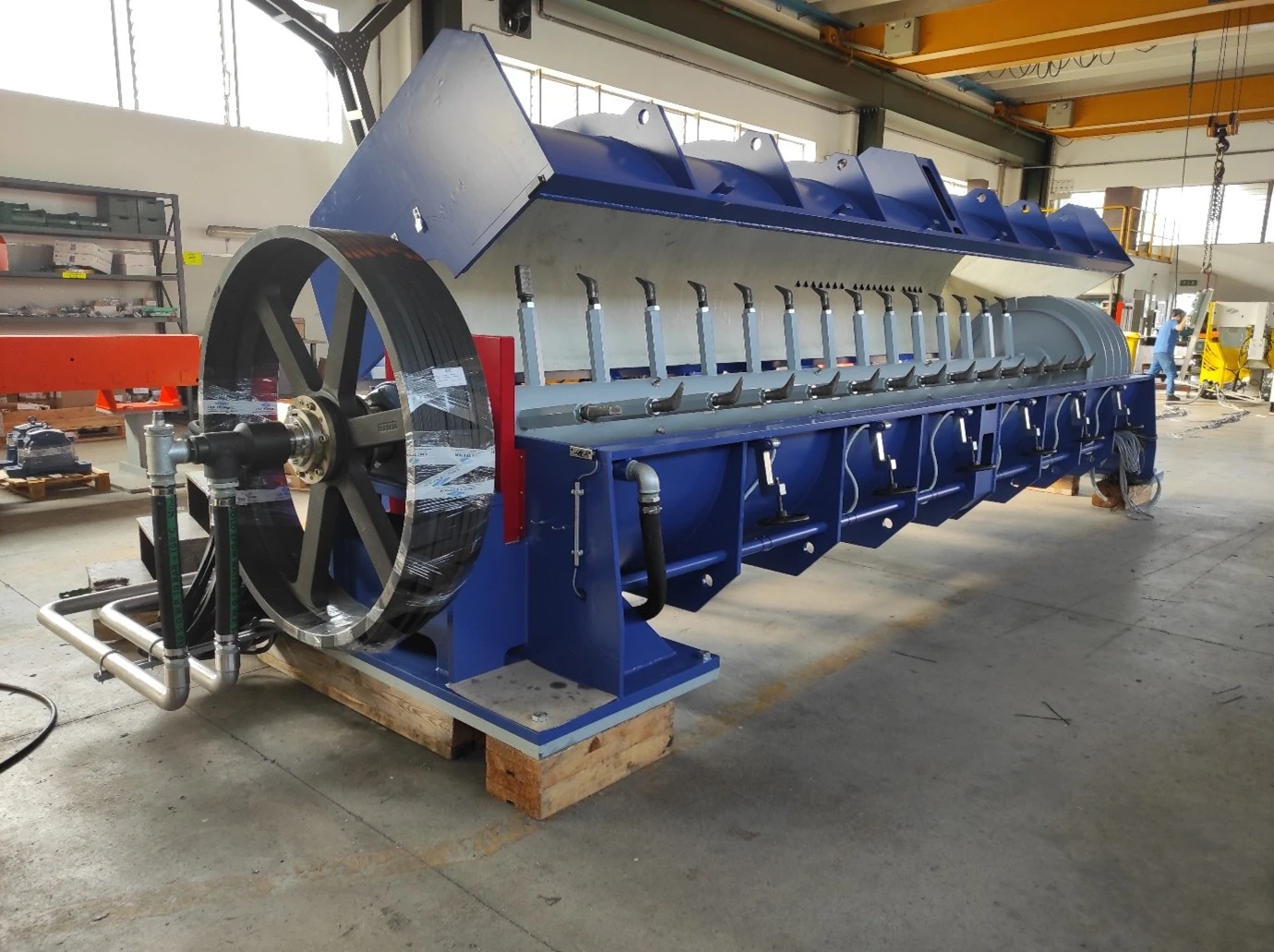
What is a glue blender and what does It do in a panel plant?
A glue blender, also called a resin blender or glue mixer, is the industrial machine responsible for applying a liquid adhesive resin uniformly onto wood particles before mat forming and hot pressing in particleboard (PB), and, sometimes, oriented strand board (OSB) production. The blender receives dried, classified wood particles from the metering bins and coats each particle with the correct amount of resin, wax, and additives through a combination of mechanical mixing and spray application.
The glue blender sits at the intersection of two parallel requirements that appear contradictory: achieving complete, uniform resin coverage on every particle while preserving the particle geometry that determines the board’s mechanical properties. Excessive fragmentation of particles inside the blender generates fine dust, increases resin consumption, and creates surface defects. Too short mixing time leaves particles under-glued, creating weak spots on the finished board.
Getting the blending stage right is not optional – it is the decisive variable for panel internal bond strength, resin consumption, formaldehyde emissions, and cost of board produced.
How a glue blender works: the core principle
Wood particles enter the blender from the metering bin via a belt scale that continuously measures the particles flow rate. This throughput signal is transmitted to the glue kitchen, which adjusts glue and additives pumps speed in real time to maintain the correct resin-to-particle ratio typically expressed as a percentage of resin content on dry wood weight.
Inside the blending chamber, rotating mixing tools (paddles, half-moon shaped tools, or special tools) move the particle mass while resin is atomised and sprayed through nozzles. The geometry and rotation speed of the tools determine two critical parameters: the retention time of particles inside the chamber and the centrifugal force exerted on them. Higher rotation speeds increase mixing intensity but also increase fragmentation and dust generation.
Our low-speed blenders are designed to maximise retention time while minimising centrifugal force. This approach preserves particle geometry, reduces dust generation, and achieves better resin distribution – all while consuming less energy per unit of production.
Retention time inside the mixing chamber can be controlled acting on the discharging cooled door (MTCU system).
This opening allows to keep a constant filling level inside the mixing chamber, so that the gluing mixture can be evenly distributed on all particles, thus avoiding any possible changes that could occur during the filling and emptying of the mixing chamber. This system is very useful when the press is producing thin boards and the particles requirement is reduced.
Surface layer (SL) blenders use half-moon shaped tools to improve guidance through the loading-mixing zone. Core layer (CL) blenders are equipped with a screw conveyor drum to avoid particle impact. A dedicated cooling system allows separate cooling of the blender shell and shaft essential for controlling resin pre-curing inside the machine.
Types of glue blenders: surface layer vs core layer
In a standard particleboard plant, separate blenders are used for the surface layer and core layer particle fractions. This is not simply a matter of capacity – surface and core particles have different geometries, moisture contents, and resin requirements, and they receive different resin formulations ,according to the board production required. Surface layer particles are finer, with a higher specific surface area, which means they require a higher resin content per unit weight to achieve the same coverage density. Core layer particles are coarser and can be blended at a different rotation speed and retention time. Using separate blenders allows each fraction to be optimised independently, reducing total resin consumption without compromising panel performance.
Surface layer (SL) blender
Handles fine particles destined for the top and bottom surface layers of the mat. The half-moon shaped mixing tools provide controlled guidance through the chamber. The result is fine, uniformly coated particles that form a dense, smooth surface layer – the surface quality that defines laminating and painting performance of the finished board.
Core layer (CL) blender
Handles coarser particles for the layer of the mat. The screw conveyor drum configuration reduces particle impact, which is critical for preserving the geometry of larger and longer particles. Core layer blending directly determines the mechanical properties and density of the board.
Key parameters that determine blender performance
| Parameter | What It Controls |
| Resin application rate (%) | Internal bond strength, formaldehyde emissions, board cost |
| Blender rotation speed | Particle fragmentation, dust generation, resin distribution |
| Retention time (seconds) | Resin coverage completeness, mixing uniformity |
| Chamber temperature | Resin pre-curing risk, glue build-up on tools |
| Wax addition (%) | Board water resistance, surface quality, press plugging risk |
| Particle moisture at blender inlet | Resin dilution, mat moisture, press factor |
The critical role of the glue kitchen in blender performance
The glue blender’s performance dipends from the glue kitchen. The glue kitchen manages the storage and dosing of resin, wax emulsion, hardener/catalyst, formaldehyde scavenger, and other additives. Inaccurate dosing of glue and additives translate directly into inconsistent panel properties that no downstream process can correct.
Our glue kitchen systems use Coriolis-type mass flow meters for resin, emulsions, and melted wax, and magnetic flow meters for all other components. The capacity set-point is continuously compared with the actual measured throughput, and the dosing pump speed is adjusted in real time. This approach provides high sensitivity to density variations – something that volume-based metering systems do not detect – ensuring accurate dosing under all production conditions.
Separate dosing tanks for surface layer and core layer allow different resin formulations to be used for each fraction without cross-contamination or manual intervention.
Common problems in glue blending and how to prevent them
Resin build-up on chamber walls and tools
Resin deposits on the internal surfaces of the blender chamber and mixing tools are one of the most common operational problems. These deposits accumulate over time, reducing the effective chamber volume, changing particle retention time, and could cause production stoppages for manual cleaning. The resin buit-up come from excessive chamber temperature, resin pre-curing and resin misting that is not absorbed by particles. Adequate cooling of shell and shaft, correct resin pH, and optimised spray nozzle positioning prevent this problem.
Particle over-fragmentation and dust generation
Over-fragmentation occurs when the blender rotation speed is too high relative to particle size and density, or when retention time is too long. The result is increased dust in the material flow, higher resin consumption (fine particles have a larger specific surface area and absorbe the glue), and surface defects in the finished board. Operating at the correct speed for each particle fraction and regularly monitoring particle size distribution at the blender discharge are the primary controls.
Uneven resin distribution
Non-uniform resin coverage produces boards with variable mechanical properties spots of high and low glue coverage. Common causes include clogged spray nozzles, incorrect pump flow, resin viscosity variations (due to temperature or concentration drift), and insufficient retention time. Continuous monitoring of resin flow rate, nozzle condition inspection, and temperature-controlled resin supply lines are the standard corrective measures. Retention time inside the chamber is very important and is guaranteed by the automatic control of the discharging door (MTCU system).
Selecting the right glue blender for your application
The correct blender specification depends on four primary factors: particle throughput capacity (tonnes of dry wood per hour), particle type (surface or core, size distribution, species), type of glue (UF, MUF, pMDI), and available installation space. Over-specifying blender capacity reduces particle retention time and degrades the mixing performance. Under-specifying creates a bottleneck that limits the entire production line.
We offer a complete range of blender sizes for both surface and core layer applications. All our blenders are custom-configured for each installation: our engineers analyse the particle characteristics, resin system, and production targets before specifying the blender geometry, tool configuration, and cooling system. See our Glue Blenders page for technical details.
Selecting the right internal coating for your application
It is very important to select the best internal coating, according to the wood particles to be blended. The particles to be processed in the blender can be of different types: fresh wood, but of different species (soft wood / hard wood) recycled wood, sawdust, ….
The silica content and acidity of the particles can differ a lot. We offer a wide range of construction types for the blender shell each designed for different types of wood. Our mixing chambers can be supplied made of stainless steel plate, made of special wear-proof material (tungsten carbides) or provided with ceramic coating.
Why choose our glue blenders?
We have been engineering glue blending systems for wood-based panel plants since the 1970s. As part of the Siempelkamp Group, we supply blenders as standalone equipment and as part of complete gluing system packages integrating metering bins, belt scales, glue kitchen, and blenders into a single coordinated system. This integrated approach eliminates interface issues between components from different suppliers and ensures that each system is optimised as a whole, not just as individual machines.
Our blenders operate in plants across 40+ countries, processing everything from standard softwood particles to challenging recycled wood fractions. We provide installation supervision, commissioning support, and original spare parts to ensure that our equipment delivers reliable performance throughout its operational life.
FAQ — Glue Blender
The glue kitchen prepares and doses the resin components; the glue blender applies that prepared resin onto wood particles through mechanical mixing. They work together as an integrated system.
How is resin application rate measured in production?
Resin application rate is measured as the ratio of solid resin content added per unit of dry wood weight, expressed as a percentage. Belt scales at the blender inlet and flow meters on the resin supply lines measure both values continuously.
Why do surface layer and core layer blenders have different designs?
Surface particles are finer with higher specific surface area and require different mixing geometry. Core particles are coarser and benefit from a screw conveyor drum design that reduces fragmentation at the typical core particle size.
What causes glue build-up inside the blender and how can it be prevented?
Build-up is caused by resin pre-curing inside the chamber, typically due to high chamber temperature or excessive retention time. Adequate cooling of shell and shaft, correct resin pH, and optimised spray nozzle positioning prevent it.
Can the same blender be used for both UF and pMDI resins?
Technically possible, but not recommended without modifications. pMDI is highly reactive and requires different nozzle materials, cleaning procedures, and safety systems compared to UF-based resins.