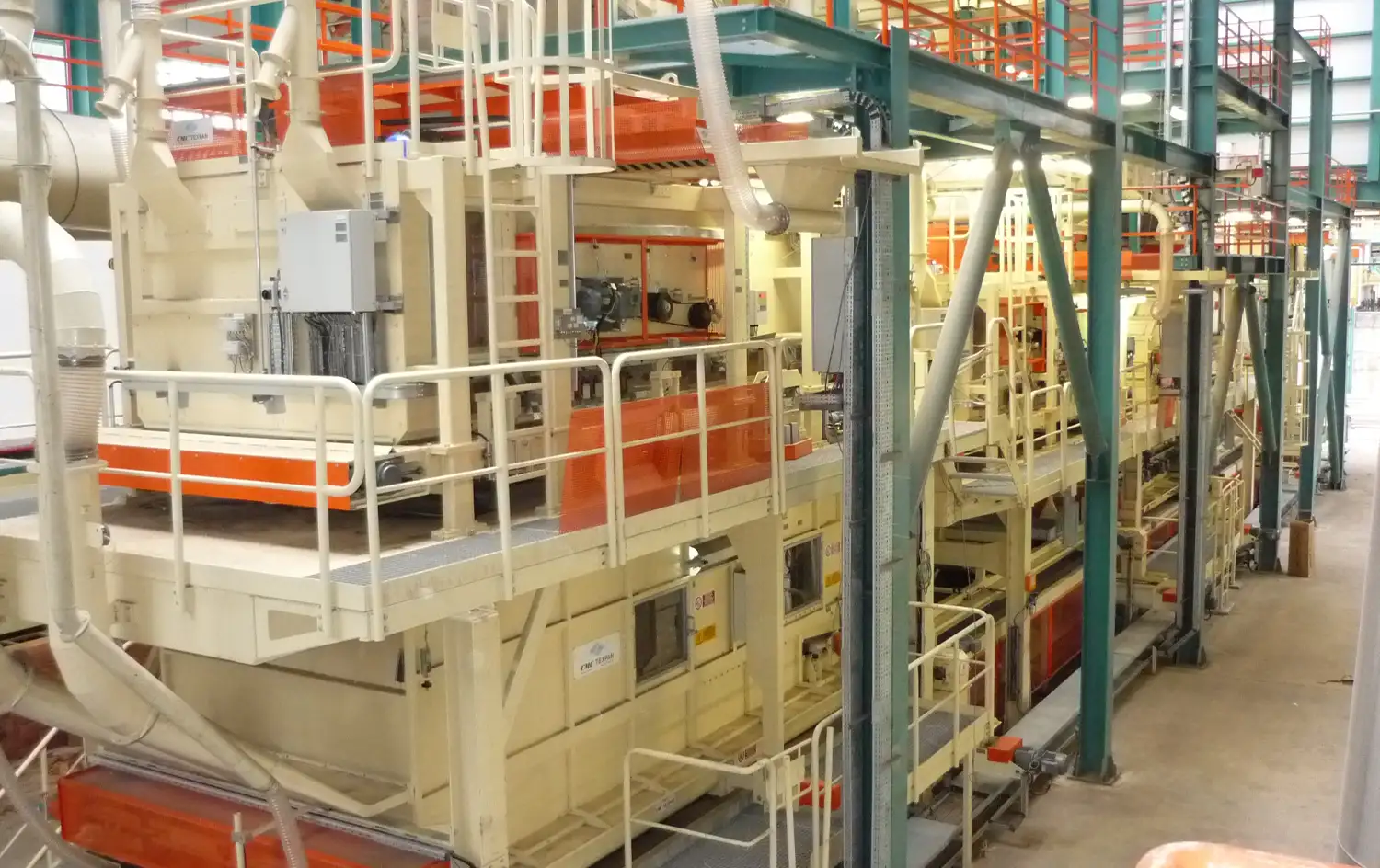
What are mat forming systems and what do they produce?
Mat forming systems are the set of machines in a particleboard production line responsible for distributing glue-coated wood particles onto a continuously moving forming belt in a specific, controlled layer structure. The output, the particle mat, is a precisely composed multi-layer carpet of particles that, after pre-pressing and hot pressing, becomes the finished particleboard panel.
The mat forming system is one of the most process-critical sections of a particleboard plant. Its output directly determines the uniformity of the finished board in terms of thickness, density, internal bond strength, and surface smoothness. Unlike many production stages where defects can be corrected downstream, forming defects are largely locked in by the press and manifest permanently in the final product.
A typical mat forming system for particleboard consists of: dosing bins (to buffer and meter the particle flow), a forming station (the mat former machines themselves), mat weighing equipment (load cell scales), and a metal detector at the press entrance. All components work in coordination to produce a mat with the correct area weight, layer structure, and absence of contaminants.
Why mat balance is the central challenge in forming
A well-balanced particle mat means two things simultaneously: correct area weight uniformity across the full belt width and in the machine direction, and correct layer structure (fine particles at the surface, coarser particles in the core). Achieving both simultaneously, consistently, over multi-hour production runs, is the engineering challenge that defines mat forming system design.
Area weight non-uniformity is the most common quality problem in particleboard production. Cross-directional weight variation, heavier on one side of the belt than the other — produces boards with asymmetric thickness and density, which can cause bowing or warping in service. Machine-directional variation produces board-to-board thickness inconsistency, which increases sanding losses and reduces yield.
Layer structure errors, incorrect surface/core particle ratios, surface layer contamination with coarse particles, produce boards with poor surface smoothness and reduced internal bond. These defects are visible in laminated panels and unacceptable for furniture-grade applications.
Wind mat formers: how airflow creates a graded surface layer
Wind mat formers are the standard technology for forming the surface layers in a particleboard mat. They work on a simple physical principle: particles of different sizes and densities behave differently when suspended in a moving airstream. Lighter, smaller particles are carried further by the airflow; heavier, coarser particles fall earlier. By controlling the airflow speed and distribution inside a forming chamber, the wind former produces a naturally graded deposit, with the finest particles on the outer face and gradually coarser particles progressing towards the core.
This graded structure is the foundation of particleboard’s surface quality. The very fine particles on the outer face of the mat form a dense, smooth surface when pressed, suitable for direct lamination with thin papers or direct painting without requiring a skim coat. Mechanical formers alone cannot achieve this level of surface refinement.
The EcoFormer SL (Surface Layer), our patented innovation, optimises this grading process by making the airflow distribution inside the wind forming chamber more efficient. Its core is a diffuser plate with specially shaped holes that provides perfect control and distribution of the airflow. The result is more uniform surface layer density, better particle gradation, and consistent forming quality across the full board width, even at high production speeds.
The ecoformer sl: technical details
The EcoFormer SL represents an evolution of the traditional wind forming concept. In a conventional wind former, airflow distribution inside the forming chamber is inherently non-uniform, the air velocity is higher near the fans and lower at the edges of the chamber. This non-uniformity produces area weight variations in the surface layer, particularly in the cross-direction.
The EcoFormer SL addresses this by introducing a precisely engineered diffuser plate between the fans and the forming zone. The diffuser plate receives the airflow blown by centrifugal fans through a plenum chamber and distributes it uniformly across the entire width of the forming area. The result is a highly uniform wind speed profile from edge to edge of the forming belt, which translates directly into uniform surface layer distribution.
A key advantage of the EcoFormer SL is that it is designed to fit in the space of a conventional wind former, making it suitable for direct retrofitting into existing particleboard lines without major civil or layout modifications. As reported by Woodworking Network, EcoFormer SL installations have delivered approximately 500,000 euros in yearly savings through material savings and energy reduction, depending on plant size.
Mechanical mat formers: forming the core layer
The core layer of the particleboard mat is formed by mechanical mat formers, which distribute coarser particles using rotating mechanical elements rather than airflow. The most common mechanical forming technologies use rotating spreading heads with rakes, rollers, or brushes to distribute particles across the belt width.
Core layer forming does not require the same level of refinement as surface layer forming, the goal is uniform distribution of a large volume of coarse particles across the full belt width, at a controlled area weight. However, the core layer mechanical former must also remove glue lumps: agglomerated particles that would create hard spots in the finished board. Disc separators or roller screens integrated into or upstream of the mechanical former serve this function.
Our mechanical mat formers are equipped with components proven over decades of industrial operation. The forming heads are designed for easy access during cleaning and maintenance, a practical requirement in operations where glue build-up on forming components is an ongoing maintenance activity.
Dosing bins: the upstream control of mat forming
The quality of mat forming begins before the forming station itself, it begins with the dosing bins that control the particle feed to the mat formers. A dosing bin is a surge vessel that stores a quantity of dried, classified particles (surface layer or core layer) and discharges them at a constant, controlled rate to the forming station.
Our dosing bins use rotary combs to level particles inside the bin and prevent bridging. The filling level is continuously monitored by level switches, and material is discharged onto a dosing belt. The dosing belt controls the particle flow rate to the forming station and provides the reference signal for any closed-loop mat weight control system.
The importance of a controlled particle feed cannot be overstated. Surges or drops in particle supply to the forming station produce immediate area weight variations in the mat, which appear as density bands in the finished board. A well-designed dosing system smooths out upstream process variations before they reach the forming station.
Mat weighing equipment: measuring and controlling forming accuracy
No mat forming system is complete without a continuous mat weight measurement system. Load cell scales are installed under the forming belt at one or more positions along the forming station to measure the mat area weight in real time. These measurements are compared to the target weight, and correction signals adjust the forming head outputs.
Our load cell scales are designed to be fitted in both new plants and existing lines. They can be installed inside dosing bins to control the density of the material fed to the mat formers, or positioned after the mat formers to measure the actual formed mat weight. The combination of both measurement points allows the control system to distinguish between feeding variations (upstream problem) and forming variations (forming head problem) , enabling targeted corrective action.
Selecting a mat forming system: key criteria
| Selection Criterion | Key Questions to Answer |
| Production capacity (m³/day) | What belt width and speed are required for target throughput? |
| Particle size distribution | What surface particle fineness is required for board grade? |
| Board quality requirements | What surface smoothness and thickness tolerance are needed? |
| Raw material type | Fresh wood, recycled wood, or alternative materials? |
| Available installation space | Is a compact system or modular layout required? |
| Retrofit vs greenfield | Does the system need to fit existing plant dimensions? |
Why choose our mat forming systems?
We have manufactured mat forming systems for wood-based panel plants since the 1980s. With approximately 200 forming stations installed worldwide, our systems operate on particleboard lines in Europe, Russia, Asia, the Americas, and the Middle East. Our portfolio covers both wind mat formers and mechanical mat formers, individually engineered for each installation.
Our key differentiator is the EcoFormer SL, a patented forming technology that improves forming accuracy while reducing energy consumption and enabling direct retrofitting into existing lines. To learn more, visit ourEcoFormer SL page or contact our technical team.
FAQ – Mat forming systems
A mat former is a single machine (wind former or mechanical former) that distributes one particle fraction. A forming station is the complete set of mat formers, dosing equipment, and weighing systems that together produce the full multi-layer mat.
Higher wind speed carries more particles further, producing a coarser surface. Lower speed deposits finer particles more uniformly. Correct wind speed calibration for the specific particle size distribution is essential for achieving the target surface gradation.
Yes, but recycled wood particles typically have a wider size distribution and may contain fine contamination. Effective pre-cleaning (gravimetric separators, screens) upstream of the forming station is essential to protect forming equipment.
Modern forming stations with closed-loop mat weight control achieve area weight tolerances of ±1–2% in the machine direction and ±1.5–2.5% in the cross-direction, depending on particle characteristics and belt speed.
Cleaning frequency depends on resin system, particle moisture, and blender performance. In most plants, forming heads require inspection every 8–24 hours and cleaning every 1–3 shifts to prevent glue build-up on forming rollers and screens.