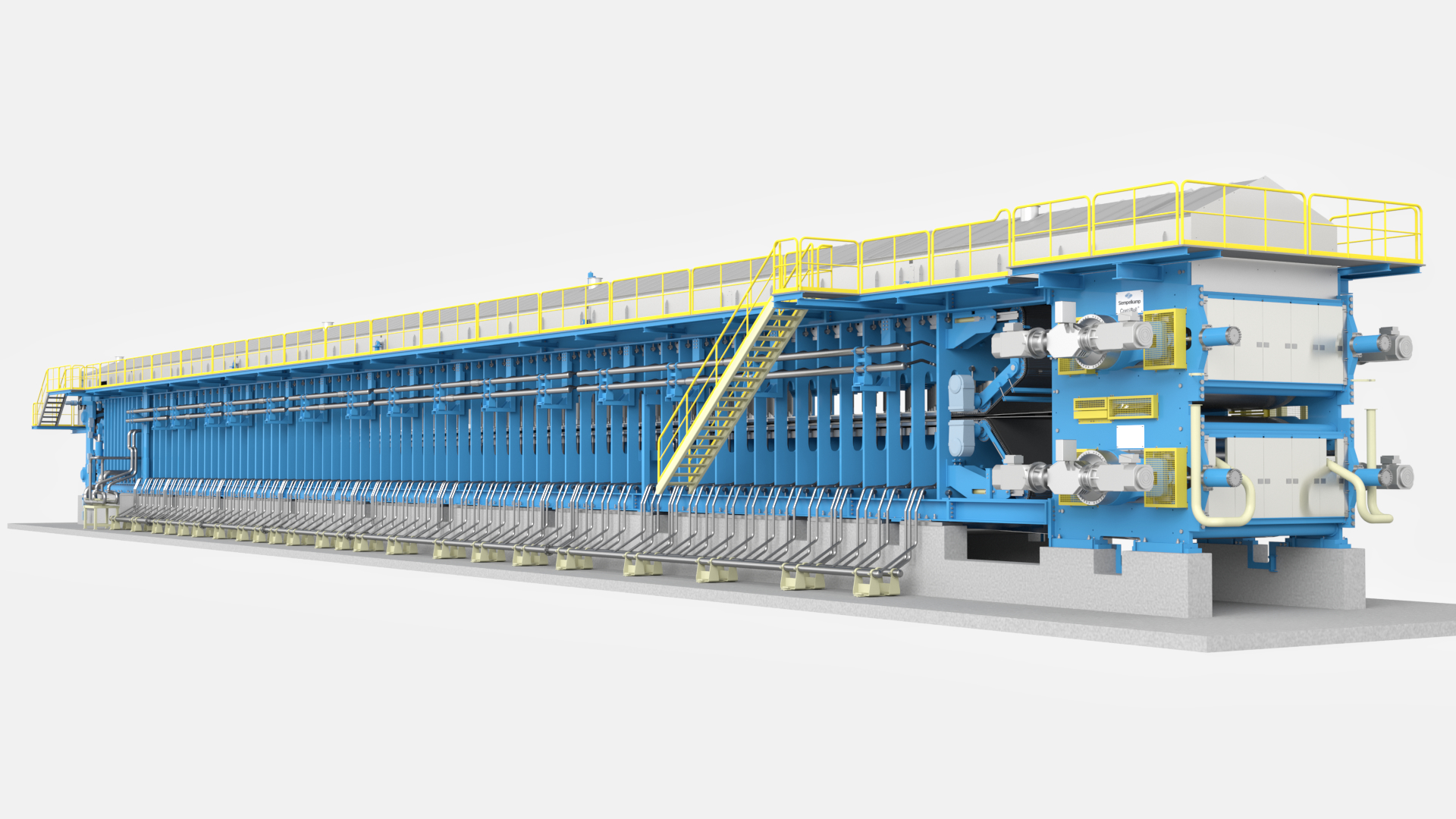
What is wood-based panel forming and why is it critical?
Wood-based panel forming – also called mat forming or spreading – is the production stage at which glue-coated wood particles, fibres, or strands are distributed onto a continuously moving forming belt to create the particle mat. This mat is the direct precursor to the finished panel: its density distribution, layer structure, and area weight uniformity determine every important quality parameter of the board that emerges from the press.
A well-balanced particle mat – with graded surface layers and a homogeneous core layer – produces high-quality panels with excellent mechanical properties and a smooth surface suitable for melamine coating, even with low-weight papers. A poorly formed mat produces density variations, thickness inconsistencies, surface roughness, and structural weakness that no downstream process can correct.
The forming station is the last opportunity to influence panel quality before pressing makes any defect permanent. This is why forming accuracy is one of the most important engineering challenges in wood-based panel production.
The structure of a particle mat: surface layers and core layer
A standard particleboard mat has a three-layer structure: two surface layers (top and bottom) made of fine particles, and a core layer made of coarser particles. This layered structure is not aesthetic – it is functional. The surface layers provide the smooth, dense face that accepts decoration. The core layer provides structural depth and reduces density (and therefore material cost) without proportionally reducing panel strength.
In the forming station, this three-layer structure is created by using separate mat formers for each fraction. Surface layer formers (typically wind-based) distribute fine particles first onto the belt, then core layer formers (typically mechanical) deposit the coarser core fraction on top of the surface layer, and finally a second set of surface layer formers deposits the upper surface layer. The result is a symmetrical, multi-layer carpet of particles ready for the press.
Getting the ratio between surface and core layers correct – and maintaining it consistently across the full belt width and over time – is the forming station’s primary engineering challenge.
Forming technologies: wind forming vs mechanical forming
Wind mat formers
Wind mat formers use precisely controlled air currents inside a forming chamber to classify and distribute particles by size and weight. Heavier particles fall closer to the air inlet; lighter particles travel further. This creates a natural gradation within the surface layer: the very finest particles end up on the outermost face of the mat, and slightly coarser particles are deposited beneath them. The result is a graded surface layer that exceeds the smoothness achievable by mechanical means alone.
The EcoFormer SL – our patented wind forming system – represents the evolution of this technology. It optimises the separation of finer and coarser flakes by making the airflow inside the wind forming chamber more efficient. The core of the EcoFormer SL system is a diffuser plate with specially shaped holes, which receives the airflow blown by centrifugal fans through a plenum chamber and provides perfect control and distribution of the airflow among the individual blowers. This precise control of airflow across the full forming width produces more uniform surface layer density and better particle gradation than conventional wind formers.
Mechanical mat formers
Mechanical mat formers distribute core layer particles using mechanical means – rotating rollers, rakes, spreader rolls, or brush arrangements – without using air. They are simpler and more energy-efficient than wind formers, and they handle coarser, heavier particles more effectively than air-based systems. Core layer formers are typically equipped with disc separators or roller screens to remove glue lumps – agglomerated resin-coated particles – that would create hard spots in the finished board.
The forming station: a complete system
The forming station is not a single machine – it is a set of coordinated machines working in sequence. A typical forming station for particleboard includes:
Two wind mat formers for the surface layers, positioned first and last in the forming sequence. One or two mechanical mat formers for the core layer, positioned between the surface layer formers. A forming belt that continuously receives the particle layers and carries them forward. Mat weighing equipment (load cell scales) positioned after the formers to measure the actual mat area weight and trigger correction signals. A metal detector before the press entrance to identify and reject any metal contamination that survived all upstream cleaning stages.
With approximately 200 forming stations supplied worldwide, we are a major global supplier of forming systems for particleboard. Each forming station we supply is individually designed for the specific plant capacity, particle characteristics, and board specifications of the customer.
Mat weighing and control: closing the loop
Producing a uniform mat is impossible without continuous measurement and control. Mat weighing equipment uses load cell scales mounted under the forming belt to measure the weight per unit area (g/m²) at multiple points across the belt width and length. These measurements are compared to the target weight, and correction signals are sent to the forming heads to adjust material flow rate or distribution.
Our load cell scales can be fitted in both new and existing production lines. They can be installed inside dosing bins to control the density of the material fed to the mat formers, or after the mat formers to control the weight of the formed mat. This flexibility allows the weighing system to be integrated at the point where it provides the most process control benefit for each specific plant layout.
The density of the furnish being fed to the mat formers, as well as the weight of the formed mat, are important factors that must be continuously monitored. Our load cell systems provide the measurement infrastructure needed to run a forming station in closed-loop control – reducing area weight variation and improving board consistency over long production runs.
Impact of forming accuracy on panel quality
| Forming Defect | Impact on Panel Quality |
| Non-uniform area weight (cross-direction) | Variable thickness and density across board width |
| Non-uniform area weight (machine direction) | Board-to-board thickness variation, sanding waste |
| Incorrect surface/core ratio | Reduced internal bond, poor surface smoothness |
| Glue lumps in mat | Hard spots in finished board, surface defects |
| Metal contamination in mat | Press damage, board rejection, production stoppage |
| Graded layer disruption | Rough surface after pressing, high paper weight needed |
Forming for MDF and OSB: key differences
While the principles of mat forming apply to all wood-based panel types, the specific requirements differ significantly between PB, MDF, and OSB. MDF forming uses fibres rather than particles – the fibre mat is typically formed using an air-laid process where fibres are suspended in an airstream and deposited onto the forming belt. The challenge in MDF forming is achieving extremely uniform fibre distribution without clumping or density waves.
OSB forming requires the orientation of strands in specific directions for each layer: surface layer strands are aligned parallel to the board length, while core layer strands are aligned perpendicular. Strand orientation is achieved using mechanical disc orienters or electrostatic systems. Our forming systems for PB, MDF, and OSB are each engineered for the specific material and layer structure requirements of those panel types.
Why choose our forming systems?
We have been manufacturing forming systems for wood-based panel plants since the 1980s, when we produced the first stationary forming station for particleboard in cooperation with Texpan. Over more than four decades of continuous development, our forming technology has evolved from conventional mechanical systems to the patented EcoFormer SL wind forming technology — which has been installed on particleboard lines across Europe, Russia, Asia, and the Americas.
Our forming stations are individually engineered for each installation and are supplied as complete, tested systems. For more information, visit our Forming Station page or contact our technical team directly.
FAQ – Wood-based panel forming
Wind forming uses controlled airflow to classify and distribute fine surface layer particles; mechanical forming uses rotating mechanical elements to spread coarser core layer particles. Both are used together in a standard forming station.
Area weight (g/m²) determines board density and thickness. Non-uniform area weight produces boards with variable thickness, density, and mechanical properties – the most common quality issue in particleboard production.
Yes. Our forming systems are designed to be compatible with existing plant layouts, including the EcoFormer SL which fits into the space of conventional wind formers for direct upgrades.
Glue lumps are agglomerations of resin-coated particles that form in the blender or transport system. In the mat, they create hard, dense spots that appear as defects in the finished board surface.
Metal detectors are installed in the forming line immediately before the press entrance. When a metal object is detected, the mat section is automatically diverted out of the press to prevent press damage.