
Forming station - FS

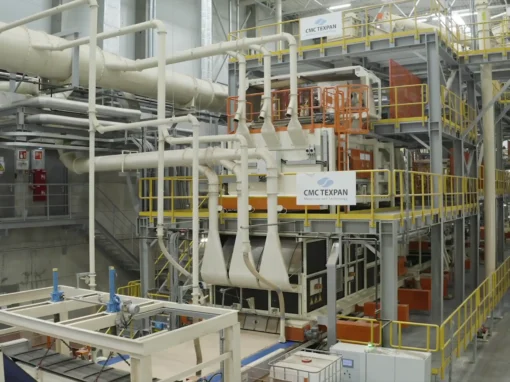
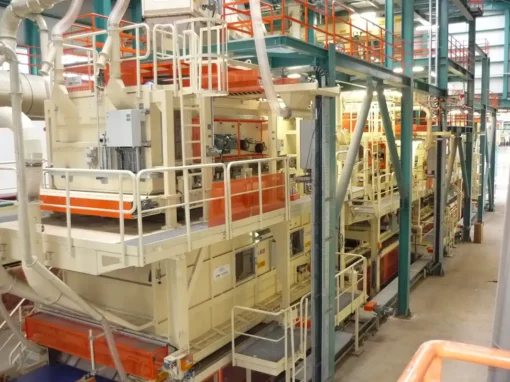
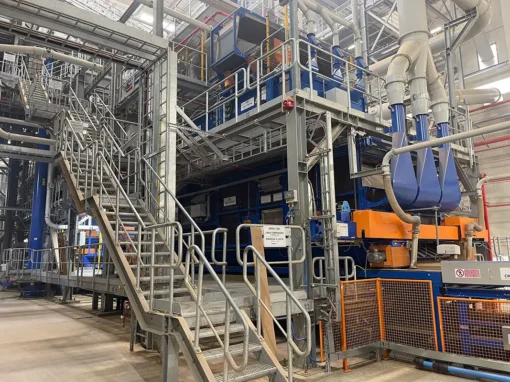
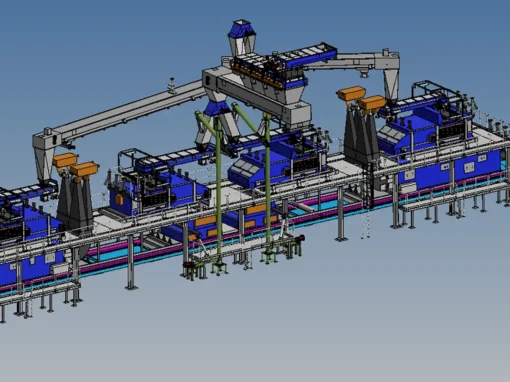
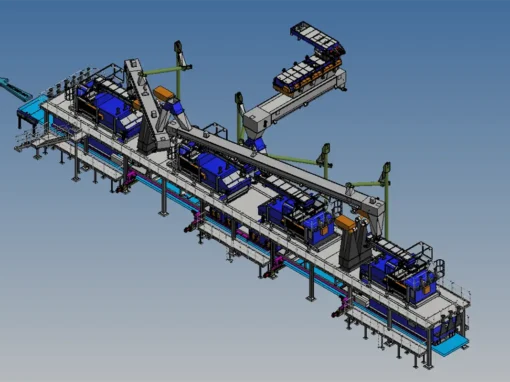
The forming station is a set of machines designed for mat forming. This is an essential step in particleboard production. Well-balanced particle mats (that’s to say Surface Layers with a graded structure and a homogeneous Core Layer), will result in high quality particleboard panels, showing excellent mechanical properties and a smooth surface, which shall be a perfect substrate for melamine coating, even with the use of low-weight papers.
With its long experience and about 200 forming stations supplied all over the world, SIEMPELKAMP Sorting & Forming is a major supplier of forming systems for particleboard.
A typical forming station basically includes two wind mat formers for the Surface Layers and one or two mechanical mat formers for the Core Layer.
Feeding system
CL feeding screw conveyor for disc separator: guarantees uniform feeding across the entire width of the disc separator by means adjustable plates on the discharge.
CL disc separator: removes glue clots and oversize particles from the furnish flow to the CL mat formers, in order to avoid damages the steel belt of the press.
CL collecting belt under disc separator: collects acceptable material underneath the disc separator.
CL and SL diverter flaps: distribute the furnish flow onto both feed conveyors below.
SL feeding belts: transports the material to the dosing bin feed system.
Forming machines
SL+CL swivelling belts: feed the doing bins equally across their entire width.
SL+CL dosing bins: discharge a constant and controlled flow of material into the forming machines below. Supplied with the internal scale, it can measure continuously the real density of the material in order to adjust immediately the dosing belt speed to ensure a precise discharge and a more uniform panel.
SL wind chamber: the two surface layers are formed in a wind forming process with the finest particles placed in the outer surface layers and the particle size gradually increasing towards the board core. “EcoFormer SL” (patented) represents an evolution of the traditional wind forming concept: it enables optimized wood separation of the finer and coarser, a more uniform and stable cross-weight distribution, easier maintenance and cleaning, reducing the consumption of glue, wood and electrical power.
CL mechanical heads: mechanical forming of a homogeneous core layer by means of a cage former. It is equipped with the edge reinforcement system, a device to deposit more material on the mat edges and make them denser for the trimming. It can be provided also with the cross-correction module, for the adjustment of the CL mat cross weight profile during continuous production.
Pressure rollers: the non-driven rollers lie on the core layer; Any particles set upright are pressed down by the rolls dead weight into the core layer to prevent them from protruding into the surface layer to be spread.
Mat width adjustment system
Width adjustment + recycling screws: the automatic system that allow the modification of the panel width to be produced. It consists in a motorized system that adjust the sidewalls of the complete mat forming line, and contemporary activate the recycling of the excess SL/CL-furnish to the SL/CL dosing bins.