What Is particleboard and why does every process stage matter?
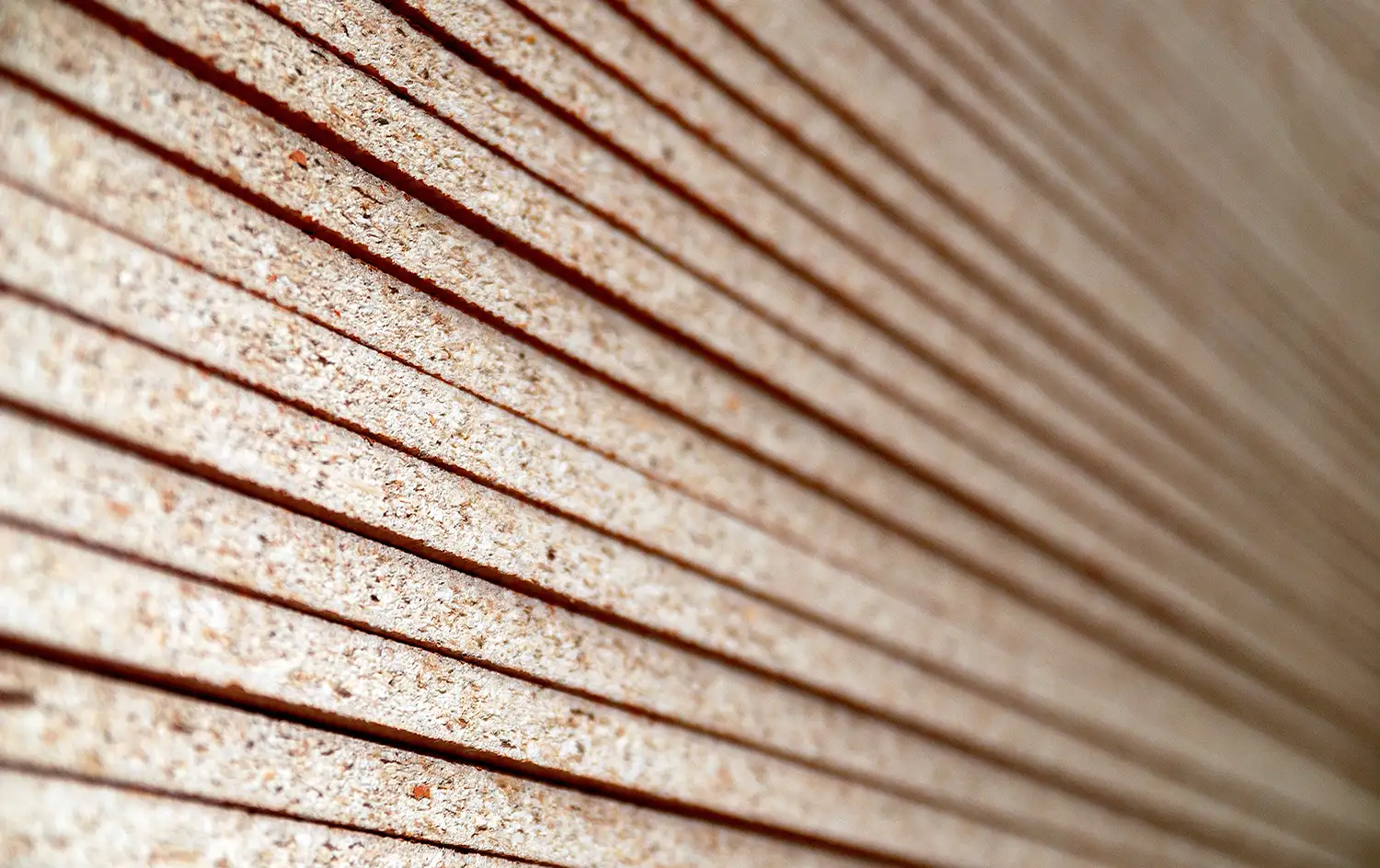
Particleboard, also known as chipboard or PB, is an engineered wood panel manufactured by bonding wood particles with a synthetic resin adhesive under heat and pressure. According to European standard EN 309, it is defined as a panel produced from particles of wood or other lignocellulosic material combined with a polymeric binder. The final panel consists of a multi-layer structure. Fine particles form the smooth surface layers, while coarser particles fill the core, reducing material use without compromising strength.
Understanding the full particleboard manufacturing process is critical for plant operators, process engineers, and equipment managers. Every stage, from raw material preparation to final board finishing, directly determines panel density, internal bond strength, surface smoothness, dimensional stability, and formaldehyde emission levels. An optimized production line minimises raw material waste, energy consumption, and unplanned downtime, all of which define the profitability of a wood-based panel plant.
Global particleboard production exceeded 110 million m³ in 2022, making it the most widely produced wood-based panel globally (NCBI, 2024). Knowing this process in depth is not academic knowledge, it is operational leverage.
Stage 1 – Raw material preparation and wood chip sourcing
The particleboard manufacturing process begins with raw material selection. The furnish, the wood particles used as input, can include logs, branches, sawmill residues, industrial wood waste, and post-consumer recycled wood. This flexibility is one of particleboard’s key competitive advantages over solid wood or plywood.
Each input type requires specific handling. Fresh wood arrives with high moisture content, up to 50% on a wet basis, while recycled wood may contain metal fasteners, plastics, stones, and other contaminants. The first mechanical step involves chipping: logs and large pieces are reduced by drum or disc chippers into wood chips of defined geometry. Disc chippers produce more uniform chip shapes, which improves the consistency of all subsequent processing.
After chipping, the material enters a pre-screening phase to remove oversized pieces and unsuitable fines. This is the first in a series of classification and cleaning operations that protect downstream machinery and guarantee panel quality.
We design and manufacture the complete range of separation and cleaning systems for PB, MDF, and OSB lines, handling both fresh and recycled wood. Our oscillating screens, roller separators, gravimetric separators, and chips cleaners are engineered for the demanding conditions of industrial particleboard plants. See our Chips & Particles product range.
Stage 2 – Particle classification and screening
Once chips have been produced, precise classification by size and weight is essential. Oscillating screens and roller separators separate the material flow into defined size fractions. Oversized particles that do not pass through the screen mesh are returned to a hammer mill or re-chipper for further reduction. Undersized fines are diverted to the energy system rather than incorporated into the panel, where they would absorb excessive resin and degrade quality.
At this stage, gravimetric and densimetric separators remove heavy contaminants, sand, stones, metal particles, that survived the initial cleaning step. These contaminants can cause catastrophic damage to knife ring flakers and continuous presses if not intercepted. The gravimetric separator uses a counter airflow to classify particles by weight and size while gently removing pollutants without damaging the particle geometry.
Our gravimetric separator (GS) is individually designed according to the characteristics of each installation, treating chips, sawdust, surface layer, core layer, and oversize particles. The machine’s key advantage is that it preserves particle geometry throughout the separation process, a critical factor for final panel quality.
Stage 3 – Drying
Wood particles must be dried to 2–8% moisture content before entering the blending stage. Excess moisture causes foam formation in the blender, uneven resin distribution, and steam explosions inside the hot press. Rotary drum dryers are the industry standard. Particles pass through a rotating drum exposed to hot gas, with inlet temperatures reaching up to 871°C for very wet furnish.
After drying, particles pass through cyclones for product recovery and are conveyed to dosing bins, holding bins that store core and surface fractions separately. The dosing bins ensure a continuous, precisely controlled particle feed to the blenders, acting as a critical buffer in the material flow.
According to the U.S. EPA Particleboard Manufacturing process guidance, dryer inlet temperatures for dry furnish are generally no higher than 260°C, while wet furnish may require up to 871°C, underscoring the importance of moisture monitoring before the drying stage.
Stage 4 – Glue blending
Glue blending is the most technically demanding stage in particleboard production. In the blender, dried wood particles are uniformly coated with liquid adhesive resin using rotating mixing tools. The precision of resin application directly determines the panel’s internal bond strength (IB).
The most widely used resin is urea-formaldehyde (UF), which accounts for approximately 98% of industrial PB production. Melamine-UF resins offer improved moisture resistance. The blender must achieve complete, even resin coverage at the lowest possible resin content, typically 8–14% solid resin on dry wood weight. Too little resin produces weak panels; too much increases cost, adds moisture to the mat, and extends press time.
Our low-speed blenders are specifically engineered to address the central challenge of blending. Preserving particle geometry while achieving uniform resin coverage. A critical issue in blending is how to preserve the geometric shape of the particles. Excessive reduction of particle size generates dust and results in spots, as well as an increase in glue consumption. Our blenders reduce the centrifugal effect on particles by operating at lower rotational speeds, maintaining longer retention times while reducing fragmentation. A dedicated cooling system allows separate cooling of the blender shell and shaft.
Our Glue Kitchen systems use Coriolis-type mass flow meters for glues, emulsions, and melted wax, and magnetic flow meters for all other components. The capacity set-point is continuously compared with actual measured throughput, and dosing pump speed is adjusted accordingly, ensuring the correct dosing of each component at all times. See our Glue Blending Systems page.
Stage 5 – Mat forming
After blending, resin-coated particles are conveyed to the forming station, where they are distributed onto a continuously moving forming belt to create the particle mat. This mat will be compressed and cured in the press to become the finished panel. The forming station must simultaneously achieve correct area weight across the full belt width and correct layer structure, fine surface particles at top and bottom, coarse core particles in the middle.
Two main forming technologies are used: mechanical forming stations (preferred for small-to-medium capacities) and wind forming stations. Wind formers use controlled air currents inside a forming chamber to classify particles by weight and size while distributing them onto the belt, achieving superior surface layer refinement and uniform mat density.
With approximately 200 forming stations supplied worldwide, we have built extensive expertise in both forming technologies. A typical forming station includes two wind mat formers for the surface layers and one or two mechanical mat formers for the core layer. The result is a well-balanced mat with graded surface layers and a homogeneous core layer, which translates directly into high mechanical properties and a smooth surface, a perfect substrate for melamine coating, even with low-weight papers.
Stage 6 – Pre-pressing and hot pressing
Before entering the hot press, the mat passes through a pre-press that reduces its thickness and compacts it for handling. It removes air from between the particles and makes the mat dimensionally stable enough to be transported into the continuous press without distortion.
The continuous hot press applies heat (typically 140–220°C) and pressure (2–3 MPa) simultaneously to cure the resin and bond the particles into a rigid panel. Press time, the press factor in seconds per millimetre of board thickness, is a key productivity parameter. Properly conditioned particles with correct moisture content, precise resin application, and uniform mat density all contribute to reducing the press factor and increasing plant throughput.
Stage 7 – Board finishing
After pressing, boards are trimmed on all sides to remove rough edges. Then passed through a star cooler to reduce temperature before further handling. Calibration sanding machines refine the surface to the required thickness tolerance and surface smoothness. Most boards are subsequently coated with decorative surfaces, melamine-impregnated papers, direct printing, or veneer, for furniture and interior applications.
Quality monitoring occurs at multiple points throughout the process. Mat weight is measured before the press, density profiles are checked during pressing, and surface quality is assessed after sanding. Continuous measurement and process control systems are essential to maintaining consistent board quality across long production runs.
Key process parameters and their impact on panel quality
| Parameter | Impact on Panel Quality |
| Particle moisture content (2–8%) | Resin distribution, press factor, bond strength |
| Resin application rate (8–14%) | Internal bond, surface quality, formaldehyde emissions |
| Mat area weight uniformity | Thickness tolerance, density variation, surface flatness |
| Press temperature (140–220°C) | Cure rate, press factor, surface delamination risk |
| Particle size distribution | Surface smoothness, core density, resin consumption |
| Contaminant content in furnish | Machine damage, board defects, production interruptions |
Why choose our equipment for your particleboard manufacturing process line?
We have been supplying machinery and systems for wood-based panel plants since 1962. As part of the Siempelkamp Group, the world’s leading supplier of complete PB, MDF, and OSB plants, we combine over 60 years of Italian engineering tradition with global technical resources. Our equipment covers the most critical process stages: wood chip preparation and cleaning, glue blending, dosing systems, and mat forming. Each machine is individually engineered for the specific material, capacity, and layout requirements of the customer’s plant.
We have supplied our solutions across 40+ countries, with more than 500 installations in operation. Our engineers have direct experience with both greenfield plants and upgrades of existing lines, giving us the process knowledge to recommend the right solution for each application. We support our customers through installation, commissioning, and the full operational lifecycle of the equipment.
FAQ – Particleboard manufacturing process
Particleboard is made from wood particles of various sizes bonded with resin. MDF uses finer wood fibres for a denser, more homogeneous panel. OSB uses large strands arranged in crossed layers for structural applications.
What resin is most commonly used in particleboard production?
Urea-formaldehyde resin is used in approximately 98% of industrial PB production due to its low cost and ease of use. Melamine-UF is used for moisture-resistant panels.
Why is particle screening so important before gluing?
Correct particle size distribution ensures the right surface-to-core layer ratio, minimises resin consumption, and prevents contaminants from damaging the blender and press.
What causes thickness variation in finished particleboard panels?
The most common causes are non-uniform mat area weight from the forming station, moisture content variation in the furnish, and press temperature or pressure inconsistencies.
Can recycled wood be used as raw material for particleboard?
Yes, recycled wood is an increasingly important raw material for PB production. However, it requires effective cleaning systems to remove metals, plastics, and stones before processing.