What are dosing bins and what role do they play?
Dosing bins are storage vessels installed at critical points in a wood-based panel production line to buffer the particle flow between process stages and discharge particles at a constant, precisely controlled rate to downstream equipment. In a particleboard or MDF plant, dosing bins are positioned primarily between the drying stage and the glue blenders and between the blenders and the mat forming station.
The fundamental purpose is to decouple two adjacent process stages that inevitably operate at slightly different rates. No industrial process is perfectly continuous: dryer throughput fluctuates with moisture variation in the incoming wood, screen discharge varies as sieves load up and are cleaned, and blender feed rate changes as particle bulk density varies. Without dosing bins to absorb these variations, every upstream fluctuation would propagate directly to downstream equipment, causing oscillating resin application rates, variable mat weights, and ultimately non-uniform board quality.
In this sense, dosing bins are a precision instrument, not a passive storage vessel. Their design, control, and maintenance directly influence the accuracy of resin application in the glue blender and the uniformity of mat formation at the forming station.
Types of dosing bins and their positions in the process
Pre-blender dosing bins (particle metering systems)
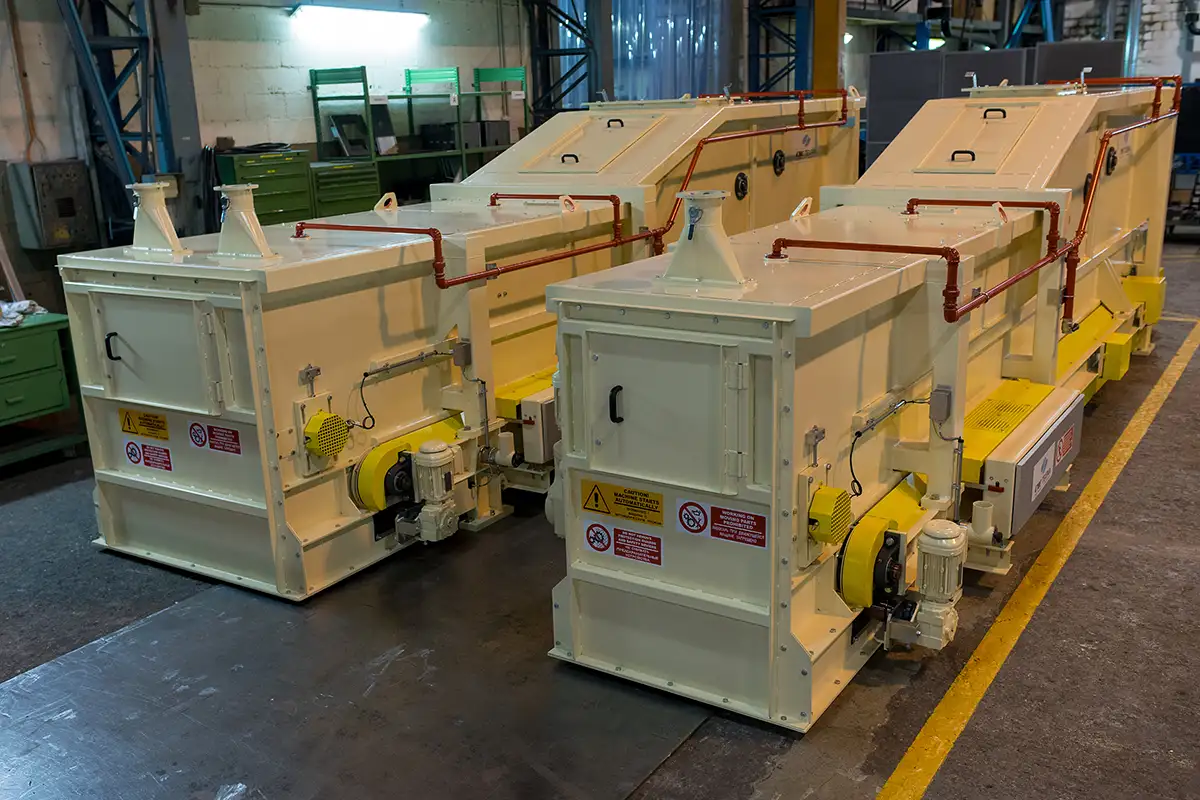
The most critical dosing bins in a particleboard plant are those feeding the glue blenders. These bins receive dried, classified particles, separately for surface layer and core layer fractions, and discharge them at a controlled rate onto the belt scale that feeds the blender. Our dosing bins are the ideal choice to ensure a constant and flawless feeding of glue blenders.
Particles inside the bin are gradually levelled by means of rotary combs, rotating mechanisms that prevent particles from bridging or forming preferential flow channels inside the bin. The filling level is continuously monitored by level switches, and material is discharged onto a dosing belt that, in combination with the belt scale, provides the actual throughput signal to the glue kitchen control system.
Pre-former dosing bins (surge bins)
After blending, resin-coated particles are temporarily stored in pre-former bins (also called surge bins) before the forming station. These bins buffer the output from the blenders, which operate as batch-like processes with startup and shutdown transitions, against the continuous requirement of the forming station for a steady particle supply.
Pre-former bins are particularly important during production startup and transitions. When the plant starts up, the blenders may take several minutes to stabilise at their target resin application rate. The surge bin allows the forming station to continue operating with in-spec material while the blenders stabilise, rather than requiring a full shutdown of the forming section.
Key design features of a high-performance dosing bin
The design of a dosing bin affects its reliability, its accuracy in metering particle flow, and its maintenance requirements. Several design features distinguish a high-performance dosing bin from a generic surge silo:
Rotary combs are the defining feature of our dosing bins. These rotating mechanisms continuously level the particle bed inside the bin, preventing the formation of channels or bridges that would cause irregular discharge. Without rotary combs, particles, particularly fine, cohesive surface layer particles, tend to bridge over the discharge opening, leading to surges and drops in material flow.
The discharge gate design determines the accuracy and range of the flow rate control. A well-designed gate can modulate flow rate smoothly across the full operating range without creating pressure fluctuations that disturb the particle bed. The belt scale immediately downstream of the discharge gate is the feedback instrument for the flow rate control loop.
Material of construction is important for abrasion resistance. Wood particles, particularly dry, fine surface layer particles, are moderately abrasive. Liner materials for the bin walls and discharge components should be selected for long wear life to minimise maintenance interventions.
The dosing bin and belt scale: a control system pair
The dosing bin is always paired with a belt scale, a weighing conveyor that continuously measures the mass flow of particles discharging from the bin. The belt scale output is the reference signal for the entire resin dosing control system: the glue kitchen adjusts its pump speeds proportionally to the particle throughput measured by the scale, maintaining the target resin application rate regardless of variations in particle throughput.
The accuracy of the belt scale therefore directly determines the accuracy of resin application. A belt scale calibration error of 1% produces a 1% systematic error in resin content. It’s invisible to the operator under normal conditions but detectable in panel internal bond strength testing and potentially in formaldehyde emissions compliance testing.
Our load cell scales can be installed inside dosing bins to control the density of the material fed to the mat formers, or positioned after mat formers to control the weight of the formed mat. This flexibility allows the weighing infrastructure to be integrated wherever it provides the most process control benefit in each specific plant layout.
Dosing bin maintenance: common issues and prevention
Bridging and hanging
Bridging where particles form a stable arch over the discharge opening, blocking flow, is the most common operational problem with dosing bins. It is most frequent with fine, cohesive surface layer particles at low moisture levels. Rotary combs are the primary prevention measure. If bridging does occur, the correct response is to momentarily reverse the comb rotation or activate a mechanical vibrator, not to jam the bridge with a rod, which can damage the discharge mechanism.
Caked deposits
In the blending area, particles inside the pre-blender dosing bin may accumulate resin deposits from misting, fine resin droplets that escape the blender and settle on the bin walls. These deposits harden over time and can fall as chunks into the particle flow, creating glue lumps in the mat. Regular inspection and cleaning of bin interior walls, particularly near the blender discharge, prevents this accumulation.
Belt scale drift
Belt scales require regular calibration to maintain accuracy. Scale drift occurs due to mechanical wear, temperature effects on load cells and material build-up on the scale belt or weigh frame. Monthly calibration using certified test weights is the standard industry practice. Any calibration deviation greater than ±0.5% should trigger recalibration before the next production run.
Optimising dosing bin performance: practical recommendations
Filling level management is the most important operational parameter. Dosing bins should be operated within a defined filling level range, typically 30–70% full, to maintain consistent discharge characteristics. Operating at very low levels increases the risk of bridging; operating at very high levels creates pressure variations that affect discharge rate.
Particle type matching is essential when changing production between surface and core layer fractions. Each fraction has different bulk density, cohesion, and flow characteristics. Transition procedures should include a brief purge cycle to clear residual material from the previous fraction.
For technical specifications on our dosing bins and particle metering systems, visit our Particles Metering Systems page.
Why our dosing bins deliver reliable performance
Our dosing bins are designed as components of an integrated gluing and forming system , not as standalone pieces of equipment. Every dosing bin we supply is configured for the specific particle characteristics, throughput requirements, and control system architecture of the plant it serves.
We supply dosing bins as part of complete glue blending system packages, integrating bins, belt scales, glue kitchen, and blenders into a single coordinated system. This integrated approach eliminates interface issues between components from different suppliers and ensures consistent performance from the first particle to the last board of every production run.
FAQ – Dosing bins
A silo is a large-capacity storage vessel. A dosing bin is a precision discharge vessel designed for accurate, controlled particle metering at production-line throughputs. Dosing bins have rotary combs, belt scale integration, and flow control features that silos do not.
Flow rate is controlled by adjusting the speed of the discharge belt (or gate opening) based on the target throughput set by the production control system. The belt scale immediately downstream measures actual throughput and feeds back to the control system.
Surface layer particles are finer and have higher cohesion due to their larger specific surface area. Fine particles create stronger inter-particle adhesion forces that can sustain a bridge across a discharge opening. Rotary combs continuously disrupt these bridges.
Yes. Our dosing bins are designed to fit within the space constraints of existing plant layouts. Retrofitting a dosing bin with rotary combs can resolve chronic bridging or flow instability problems in plants that originally used simpler surge vessels.
Throughput surges or drops from the dosing bin cause the belt scale to register incorrect particle flow, which the glue kitchen’s control system interprets as needing more or less resin. The result is variable resin application and variable internal bond strength in the finished board.