Why wood chips cleaning is critical in panel production
Wood chips cleaning, the removal of contaminants from the wood particle flow before it enters the press, is one of the most important and often underestimated aspects of particleboard, MDF, and OSB production. Contaminants in the particle flow are not merely a product quality problem: they are an equipment protection problem. Metal objects, stones, and dense fragments that reach the hot press can cause catastrophic damage to press belts, platen surfaces, and forming belts, resulting in production stoppages that last days and repair costs in the tens or hundreds of thousands of euros.
Beyond equipment protection, cleaning quality directly affects panel quality. Stone and mineral particles embedded in the wood furnish create hard spots in finished boards, generate surface defects, and can cause quality rejections. Bark inclusions, while less immediately damaging to equipment, reduce surface quality and internal bond strength.
The challenge of wood chips cleaning has grown significantly as the share of recycled wood in the raw material mix has increased. Post-consumer recycled wood typically contains ferrous and non-ferrous metal fasteners, plastics, stones, concrete fragments, and other contaminants at much higher concentrations than fresh wood. Effective cleaning of recycled wood requires a more comprehensive, multi-stage approach than fresh wood processing.
Types of contaminants in wood chips and their risks
| Contaminant type | Risk to Equipment and Panel Quality |
| Ferrous metals (nails, screws, bolts) | Severe damage to knife ring flakers, press belts; board rejection |
| Non-ferrous metals (aluminium, copper) | Damage to flakers and refiners; board contamination |
| Stones and sand | Rapid wear of cutting tools, screen meshes, and press surfaces |
| Heavy plastics (PVC, rubber) | Chemical contamination of boards; formaldehyde scavenger poisoning |
| Oversized wood pieces (knots, large bark) | Mat forming irregularities; density variation in finished boards |
| Fine sand and mineral dust | Accelerated wear of all moving parts; press surface scratching |
Stage 1 – Oscillating screens: size classification and gross oversize removal
Oscillating screens are typically the first cleaning and classification stage in the wood particle flow. They provide precise classification of wood material into different fractions by size, separating oversize material (which is returned to re-chipping), acceptable-size particles for production, and undersized fines (which are typically diverted to the energy system).
Our oscillating screens are suitable for both wet and dry materials, particles and chips. They operate on the principle of oscillation of a sifting case equipped with several sifting decks. The vibration intensity is adjustable by means of counterweights, allowing the screening parameters to be optimised for different material characteristics. Screens with fine mesh size are equipped with an automatic cleaning system using rubber balls to prevent mesh blinding.
An important design consideration for oscillating screens is the specific screening parameter, the material flow rate per unit of screen area (m³/h/m²). Oversizing the screen to create a comfortable safety margin actually reduces screening efficiency because it reduces the material layer thickness that drives particle separation. Our screen designs are calculated to achieve the correct specific load for each application.
Stage 2 – Roller separators: wet and dry material classification
Roller separators provide classification of wood material based on particle thickness, complementing the size-based classification of oscillating screens. They are particularly effective for processing wet or semi-wet wood, where oscillating screens may have difficulty with material that tends to clump or blind the mesh.
Our roller separators are high-performance machines ideal for processing both fresh and recycled wood. They are engineered for the demanding conditions of industrial wood processing, handling wet, sticky, or contaminated material that would challenge conventional screening equipment. The easy and quick modification of the fractions to be screened and the very maintenance-friendly design reduce downtime for cleaning and adjustment.
Stage 3 – Gravimetric separators: removing heavy contaminants by density
The gravimetric separator is the primary machine for removing heavy contaminants, stones, metal pieces, dense plastics, and mineral fragments, from the wood particle flow. It works on the physical principle of gravity: in a fluidized particle bed created by a controlled upward airflow, particles sort themselves by density. Lightweight wood particles are carried upward by the airflow and exit through the top of the chamber; heavier contaminants settle downward against the airflow and are discharged separately.
The core of our gravimetric separator (GS) is a fluidising and classification chamber crossed by a counter airflow. Material is introduced from the top and gently settles in the lower section thanks to a rotating spreader, ensuring uniform distribution across the whole chamber area without breaking particles. An airflow injected into the distribution chamber at a pre-set speed provides both fluidisation and classification.
A critical design feature of our gravimetric separator is that it preserves particle geometry throughout the separation process. Unlike mechanical separators that use impact forces to classify material, the gravimetric separator uses only gentle airflow, meaning that particle fragmentation and dust generation are minimised. This preserves the particle quality that the upstream flaking stage produced.
Stage 4, Chips Cleaners (Densimetric separators): Intensive Dry Cleaning
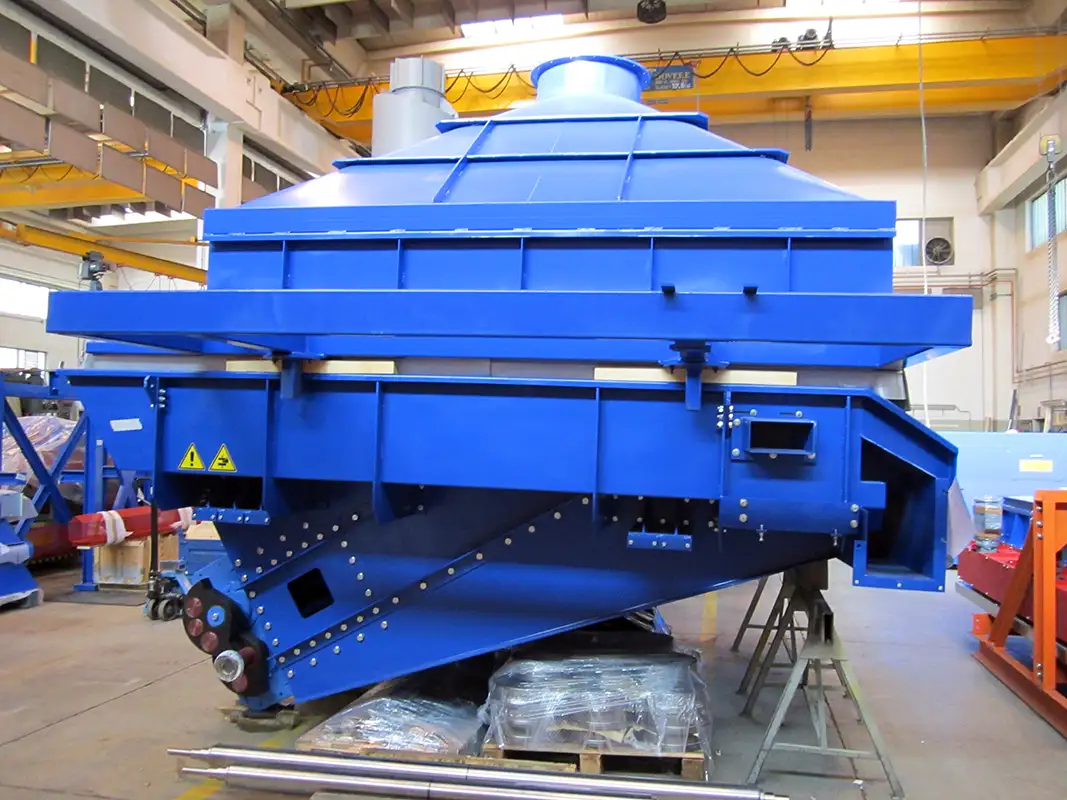
The chips cleaner combines two physical principles, vibration and pulsating airflow, to provide intensive dry cleaning of wood chips and particles. It is installed for the treatment of material that requires more thorough cleaning than a gravimetric separator alone can achieve, particularly for recycled wood fractions with high contaminant loads.
The densimetric separation effect of vibration is combined with a strong pulsating airflow to provide a further “dry cleaning” of the chips. The combination of vibration and air pulses stratifies the material in the treatment chamber: denser, heavier contaminants migrate to the bottom and are discharged separately; clean wood particles float in the upper layer and exit through the normal product discharge. The result is a clean, stratified particle flow with significantly reduced contaminant load.
Stage 5 – Magnetic separators: ferrous metal removal
Magnetic separators are the simplest and most reliable method for removing ferrous metal objects, iron and steel nails, screws, bolts, wire, and other ferromagnetic pieces, from the wood chip flow. They are installed at multiple points along the conveying system, typically at belt transfer points where material is falling freely and the magnetic separator can intercept all material in the stream.
Our magnetic separator systems provide efficient solutions for removing metal contaminants from material flows with advanced magnetic systems. They protect all downstream machinery, particularly knife ring flakers, oscillating screens, and hot presses, from the sudden, catastrophic damage that a ferrous metal object can cause. Even a single large bolt reaching the knife ring flaker can result in days of downtime and significant tooling replacement cost.
Designing a multi-stage cleaning system: the right machine at the right point
Effective wood chips cleaning is not achieved by a single machine, it requires a multi-stage system where each machine addresses a specific type and size range of contaminant, and where machines are positioned at the optimal points in the process flow. The design of a cleaning system must balance cleaning efficiency, particle preservation, energy consumption, and maintenance requirements.
For fresh wood processing, a typical cleaning system includes oscillating screens for size classification, a gravimetric separator for heavy contaminant removal, and magnetic separators at key belt transfer points. For recycled wood fractions, the system is augmented with roller separators, chips cleaners, and potentially non-ferrous metal detectors and eddy current separators.
We design complete cleaning systems for PB, MDF, and OSB plants, integrating our oscillating screens, roller separators, gravimetric separators, chips cleaners, and magnetic separators into a coordinated system. For technical details, visit our Chips & Particles product section.
FAQ – Wood chips cleaning systems
Ferrous metal objects (nails, bolts, wire) are the most immediately dangerous, they can destroy knife ring flakers and press belts in seconds. Stones are the second most critical, causing rapid abrasive wear of all cutting and screening surfaces.
Both use density-based separation, but a gravimetric separator uses a continuous, steady airflow; a densimetric separator (chips cleaner) combines vibration with pulsating airflow for more intensive treatment of heavily contaminated material.
Magnetic separators should be installed at every belt transfer point where material is in free fall, and definitely before the knife ring flaker, before the forming station, and before the press entrance.
Standard cleaning systems effectively remove metals and stones from recycled wood. Plastics with density close to wood are more challenging and may require additional equipment such as NIR (near-infrared) optical sorters for effective removal.
Screen meshes should be inspected daily and cleaned as needed (frequency depends on material type). Gravimetric and densimetric separators require weekly inspection of internal components and monthly calibration of airflow settings.