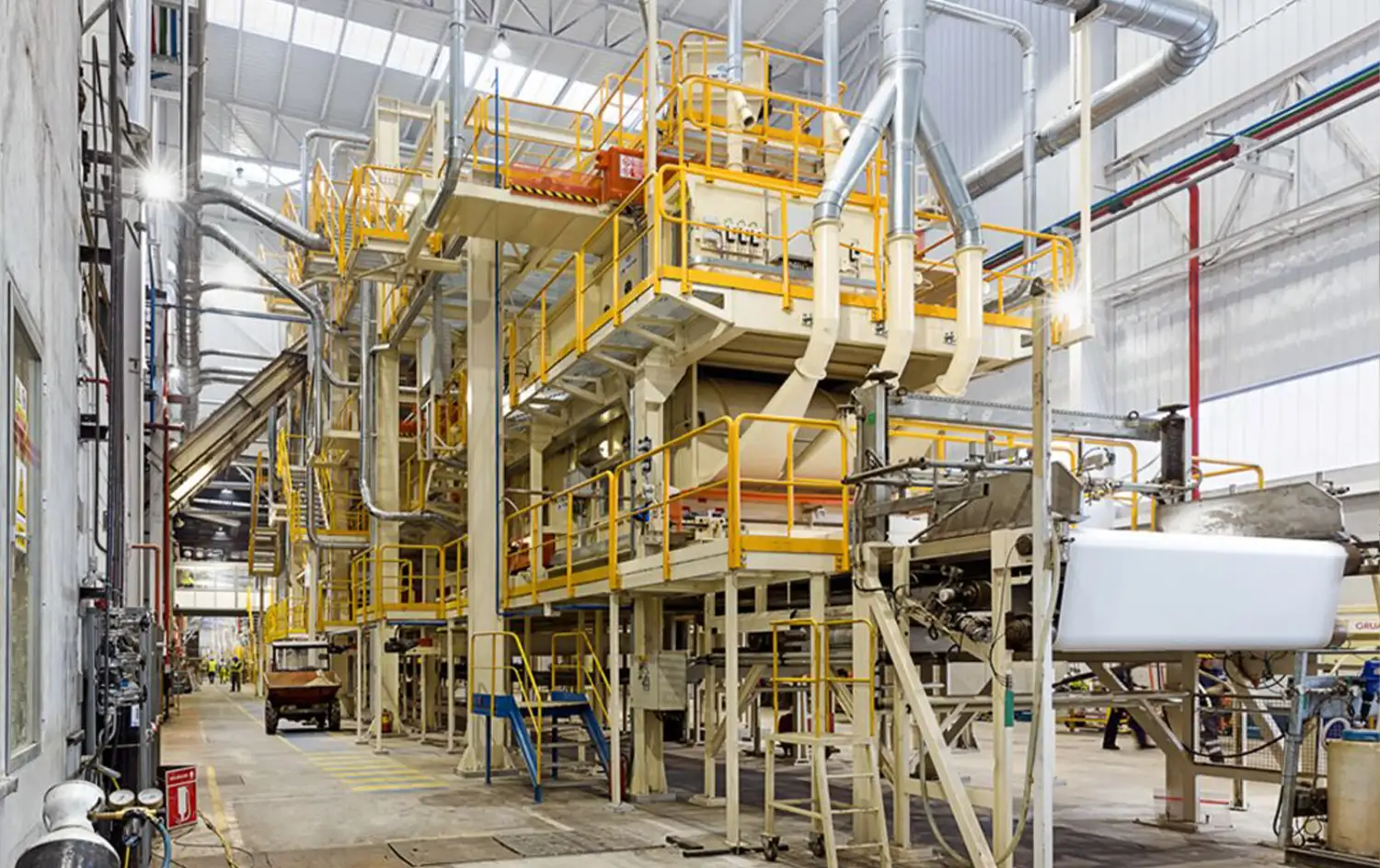
What is a forming line?
A forming line in a wood-based panel plant is the complete, integrated production section responsible for creating the particle mat that will be pressed into the finished panel. It encompasses all machines and systems from the dosing bins (which buffer and meter the glue-coated particle flow) through to the press entrance, including the mat formers, forming belt, mat weighing equipment, and metal detector.
The forming line sits between two of the most capital-intensive sections of the plant: the gluing system (which produces glue-coated particles at high precision) and the continuous hot press (which is the single most expensive piece of equipment in the plant). The forming line’s job is to translate the precisely prepared particle flow from the gluing section into a uniform mat that can enter the press and exit as a high-quality panel.
A well-designed forming line maximises the efficiency of both upstream and downstream sections. It smooths out variations in the gluing system output, maintains consistent mat quality across long production runs, and provides the press with the most uniform possible input, enabling the press to operate at its optimal speed and press factor.
Architecture of a complete forming line
A complete forming line for particleboard production typically has the following sequence of components:
Dosing bins (pre-former surge bins for surface and core layer fractions) → Belt conveyors to the forming station → Surface layer mat formers (wind formers, typically 2) → Core layer mat formers (mechanical formers, typically 1–2) → Surface layer mat formers (wind formers for upper surface layer) → Forming belt (continuous) → Load cell mat scales (mat weight measurement) → Metal detector → Pre-press conveyor.
In MDF and OSB lines, the architecture differs in important ways. MDF forming lines typically use a single, wide forming head that distributes fine fibre uniformly across the belt. OSB forming lines require dedicated strand orientation systems for each layer. Our forming systems are designed and supplied for all three panel types, PB, MDF, and OSB, with configurations appropriate to each.
The forming belt: the foundation of the forming line
The forming belt is the continuous conveyor surface onto which all mat former machines deposit particles. It runs continuously at a speed that, combined with the particle discharge rate from the mat formers, determines the mat area weight. Belt speed is a primary production parameter: increasing belt speed reduces mat area weight (thinner boards); decreasing belt speed increases area weight (thicker boards or denser panels).
The forming belt is one of the highest-wear items in the forming line. It is in continuous contact with abrasive particles, subject to load from the mat weight above, and must maintain dimensional stability for accurate mat weight control. Belt tension, tracking, and surface condition must be monitored regularly. A damaged or mis-tracking forming belt produces area weight variations that appear as thickness defects in finished boards.
Mat weighing in the forming line: closed-loop control
Continuous mat weight measurement and closed-loop control is the key technology that differentiates a high-performance forming line from a basic one. Without closed-loop control, area weight variations from all upstream sources, dryer cycling, dosing bin discharge surges, forming head wear, accumulate in the mat and produce variable board thickness.
With closed-loop control, load cell scales continuously measure the actual mat weight at one or more positions along the forming line. The measured weight is compared to the target weight, and the control system automatically adjusts the forming head discharge rate (by modifying dosing belt speed or forming head settings) to correct deviations. The correction can be applied within one mat length, dramatically reducing the variance of board thickness in production.
Our load cell scales provide the measurement infrastructure for this closed-loop system. They are designed for installation in both new forming lines and as retrofits into existing lines, providing immediate improvement in forming accuracy without requiring major line modifications.
Metal detection in the forming line
A metal detector is installed in the forming line immediately before the press entrance, the last line of defence against metal contamination reaching the press. When a metal object is detected in the mat, the forming line control system activates a mat diversion mechanism that redirects the contaminated mat section away from the press entrance into a reject conveyor.
The importance of this protection cannot be overstated. A single metal object, even a small bolt or nail fragment, reaching the pressing zone of a continuous press can cause damage to the press belts running into hundreds of thousands of euros and a production stoppage of several days. The metal detector is therefore one of the highest-return investments in a panel plant.
Forming line performance parameters and their targets
| Performance Parameter | Typical Target / Best Practice |
| Mat area weight CV (machine direction) | < 1.0% coefficient of variation |
| Mat area weight CV (cross-direction) | < 1.5% coefficient of variation |
| Surface layer thickness uniformity | ±0.2 mm across belt width |
| Mat surface temperature at press inlet | Ambient (pre-press not used) or controlled |
| Metal detection sensitivity | ≥ 1 mm ferrous sphere equivalent |
| Forming line availability | > 95% of scheduled production hours |
Common forming line problems and their root causes
Cross-directional weight variation
The most common forming line quality problem: the mat is heavier on one side of the belt than the other. Root causes include uneven particle distribution from the forming heads (worn spreader elements, blocked discharge slots), non-uniform airflow distribution in wind formers, or belt tracking drift. The EcoFormer SL specifically addresses uneven airflow distribution in wind formers through its diffuser plate design.
Machine-directional weight variation (periodical)
Periodic weight variation in the machine direction, repeating at regular intervals, indicates a rotating component problem: eccentricity in a forming roller, worn belt drive, or cyclic variation in the dosing bin discharge. The period of the variation (converted to a machine frequency using belt speed) identifies the responsible component.
Glue lumps in the mat
Glue lumps, agglomerated particles from the blender or transport system, create hard spots and surface defects in the finished board. Prevention requires good blender maintenance (controlling temperature and cleaning schedule), effective disc separator operation on the core layer forming heads, and regular inspection of transport conveyors between the blender and the forming station.
Forming line upgrades: what to prioritise
For plant operators considering forming line upgrades, the highest-return investments are typically: replacement of conventional wind formers with EcoFormer SL technology (improving surface layer uniformity and reducing energy consumption); installation or upgrade of closed-loop mat weight control systems (immediately reducing board thickness variation); and installation of disc separators on core layer forming heads (reducing glue lump defects in finished boards).
Each of these upgrades can be implemented during a planned maintenance shutdown with minimal disruption to production, and each delivers measurable improvements in board quality and production efficiency. Our engineers provide detailed engineering assessments of existing forming lines and recommend the upgrade sequence that delivers the fastest return on investment.
Why our forming lines are installed in over 40 countries
We have been manufacturing forming systems for wood-based panel plants since the 1980s. Our installations span four continents and cover production capacities from small-scale plants to high-speed, high-volume continuous press lines. This breadth of experience means that our engineers have encountered and solved virtually every forming line challenge that exists in industrial particleboard production.
We supply forming lines as complete, tested systems, not as individual components. Every forming line we supply includes the mat formers, belt, weighing system, control integration, and metal detector, all configured to work together from the start of commissioning. This integrated supply model eliminates the integration risk that arises when forming line components are sourced from multiple vendors.
FAQ – Forming lines
A forming station is the group of mat former machines. A forming line includes the forming station plus all upstream (dosing bins, conveyors) and downstream (belt, weighing, metal detector) components that together produce and deliver the mat to the press.
Higher belt speed reduces mat area weight (thinner boards at the same forming head discharge rate). Thickness is primarily controlled by adjusting belt speed relative to the total particle discharge rate from all forming heads.
Periodic variation is caused by rotating components with eccentricity or wear, typically forming rollers, belt drives, or dosing bin discharge mechanisms with a cyclic pattern. The period identifies the responsible component.
During startup, the forming line runs at reduced speed until all forming heads are operating stably and the mat weight is within specification. Load cell feedback enables rapid correction of initial weight deviations before the first mat section enters the press.
Yes, within limits. Adding forming heads increases throughput capacity, but belt width, press width, and dosing bin capacity must all be matched to the higher production rate. We provide engineering assessments for capacity increase projects